Monday, 21 June 2010

Oil Drilling Simulators Increase Safety, Efficiency, and Cost Savings

With everything going on in the news right now about the oil spill in the Gulf of Mexico, it’s clear that the drilling industry needs to increase the amount of training their personnel receive. Interactive 3D simulators are an essential components of a training curriculum when it comes to complicated systems like oil or gas rigs - where a small mistake can lead to a catastrophic accident.

Oil and Gas Training Simulator

KCA Deutag, an international oil and gas services company based in the UK, has developed a real-time 3D drilling simulator that gives users virtual hands-on training for rig and drilling operations. The simulator allows a rig crew to train and practice for the drilling of wells in an environmentally and physically safe way. Mistakes made during simulated sessions will have no effect on the surrounding environment, serve as a lesson for what not to do, and allow operators to avoid making the same mistake in the real-world.

Oil Rig Training Simulation

Drilling Systems Limited, another UK-based company, offers their own line of simulators for the oil and gas industry. The simulators deliver operator training for well sites, wellheads, refineries, offshore cranes, and port cranes. Training oil and gas rig operators on a simulator, rather than the real-world facility, can help to reduce the risk to the environment and the amount of rig downtime – both of which lead to a more predictable bottom line.

Virtual Oil Rig Operational Procedure Training

Kongsberg Gruppen, a Norwegian-based company that supplies high-tech systems to the oil and gas industry, merchant marine, and defense and aerospace industries, offers a training simulator for the oil and gas industry as well. Kongsberg’s K-Spice is a process simulator for detailed design and verification of oil and gas processes and control systems at all stages of the process. Kongsberg’s clients report the simulator is an invaluable tool for oil rig operational procedure training, which translates into operator confidence and a increased level of productivity.

If you’re tasked with training personnel to operate complicated systems like oil rigs, you’re aware of the safety and financial risks associated with conducting training on real-world facilities. Interactive 3D simulators give your operators the ability to learn and train effectively while reducing physical, environmental, and financial risks.

Monday, 19 April 2010

Medical Training Simulators Improve Hospital's Bottom Lines

Medical training simulators are rapidly becoming one of the most effective and popular uses of simulation-based training software. Medical training simulations can improve the bottom line by providing safe and relatively inexpensive training across many different medical specialties. In addition to providing new training for existing surgical procedures, medical training simulators are critical when it comes to training surgeons for robot-assisted surgeries which are becoming more common every day. Everyone benefits from medical training simulators, including medical and surgical equipment manufacturers, hospital administrators and surgeons, and even patients.


Simulated Surgical Systems provides a Robotic Surgical Simulator (ROSS) that is used to familiarize and train surgeons on the da Vinci robotic-assisted surgery system, practicing everything from cutting tissue and sewing incisions, to complete surgical procedures. The ROSS is divided into three levels:
  1. Motor skills: teaches surgeons the hand-eye coordination skills necessary to work with the robot.

  2. Clinical applications: teaches surgeons how to perform the specific elements of surgical procedures.

  3. Procedures: surgeons must perform virtual hysterectomies and prostatectomy, the 2 most commonly preformed robotic surgery procedures.
Medical simulations are becoming so popular that Banner Health has just established the Banner Simulation Medical Center, a virtual hospital used to train physicians and nurses before they ever treat actual patients.


The Banner Simulation Medical Center, located in Mesa, Arizona, is a 55,000 square foot facility capable of training more than 1,800 medical personnel on patient care situations common to intensive care units, emergency rooms, and operating rooms (including virtual surgery simulators).


Click to watch the Banner Medical Center Grand Opening Video

Health and Hospitals and the City of New York have also started construction on a medical simulation center that will be New York City's largest and most advanced medical training technology center. This $10 million, 10,000 square foot facility located on the Jacobi Medical Center campus in the Bronx, will simulate emergency room, operating room, and other patient care settings to help train health care professionals to master medical procedures. Expected to be completed by the fall of 2010, the simulation center will be able to train 14,000 medical professionals in it's first 3 years of operation.

Medical training simulators are revolutionizing medicine, changing the age-old approaches to training and teaching, and challenging the status quo. Taking advantage of the latest technology allows forward-thinking companies and hospitals to stay ahead of their competitors by providing the highest level of medical training, in a virtual environment where the worst-case scenario is a reboot, and not the loss of an actual patient.

Hospitals have found that the use of medical training simulations can reduce the amount of surgical errors, create time savings in both procedural and instructional settings, provide a reduction in real-world equipment repair costs (due to less trainee access), as well as provide a revenue stream by selling training time on the simulator. Medical training simulators allow for enhanced recruiting, better trainee evaluation, and a higher overall quality of care.

Thursday, 8 April 2010

UPS Trains Drivers With Interactive 3D Driving Simulators

If the training of drivers is part of your business, then driving simulators are for you. United Parcel Service, in an effort to fix the 30% flunk rate of candidates for their almost 100,000 U.S. based driver positions, have integrated an interactive 3D driving game into their training curriculum.


UPS Integrad is a next-generation training facility located just outside of Washington, D.C., with a second location opening in Chicago soon. Using a collection of simulations, employee candidates train for the company's "340 Methods", practices created by their industrial engineers meant to save money and time, as well as improve safety.

In a Wall Street Journal article titled "UPS Thinks Out of the Box on Driver Training", Jennifer Levitz reports that other companies like FedEx, Cisco, and Sodexo are also using simulation-based tools to train their employees.

Companies that adopt new technology are more likely to beat their competitors and survive in turbulent economic times. Driving simulators have been proven to be effective educational tools that teach safe driving techniques to operators of all classes of vehicles.

UPS plans to hire 25,000 new drivers over the next five years, their revenue is predicted to increase 8-10% in 2010, and the S&P gives their stock a 4 star buy rating - they must be doing something right. Does your company provide simulation-based training?

Tuesday, 6 April 2010

Driving simulators prove useful for new drivers

With the always increasing cost of gas, and the speed of computers, driving simulators have proven to be cost-effective and useful tools when it comes to training new drivers. These days just about every entry level computer you can buy comes with hardware acceleration capable of running real-time 3D simulations. Coupled with a USB steering wheel/pedal set and you're staff is ready to hit the virtual road.


SimuRide, developed by AplusB Software, is a personal driving simulator for beginners who are studying for their driver's license test. This home-based simulator provides a safe introduction to operating a vehicle, where students can practice their driving skills in a virtual world, without the need for expensive gas, supervision, or even a driver's permit. Drivers can gain an understanding of complex maneuvers like parallel parking, passing other vehicles, and merging onto a highway before they ever enter a vehicle.


Available in both Home and Professional versions, the SimuRide Home Edition is available for $75 while the Professional Editions cost between $800 and $1,000. For another $100 you can purchase alcohol glasses for the simulator that simulate drunk driving. http://aplusbsoftware.com/online-shop-us.html

Just like flight simulators are the natural choice for new pilots, driving simulators are a natural choice when it comes to training students how to drive a car. When training is required for specialized vehicles that simulators are not commercially available for, companies turn to simulator software development companies to produce training simulators for their operators. For example, ForgeFX developed an Aircraft Deicing Simulator for Global Ground Support's customers to train to operate the equipment:
http://www.free-press-release.com/news/200902/1234202704.html

Monday, 29 March 2010

CNN report on simulating roadside bombs

With improvised explosive device (IED) attacks more than doubling in the past year in Afghanistan they have become the number one threat to soldiers. The US Army is turning to a training simulator to help prevent soldiers from dying in IED attacks.


The simulator trains soldiers to look for "signatures and observables" that are indicators of potential IED attacks. The training simulator uses up-to-date intelligence and data gathered at a military operations center near Ft. Eustis, Virgina. This data is analyzed and converted for use by the game development engine that runs the simulation software. This allows the simulation to accurately replicate current combat conditions, providing soldiers with valuable training.


When the safety of a nation is at stake, simulation-based learning is a clear cut choice in training. For other mission-critical tasks, and when lives are in the balance, interactive 3D training simulators lead to a higher level of success.

Friday, 26 March 2010

Caterpillar Provides Cost Saving Training Simulators

If you're in the heavy equipment industry, simulators can provide cost savings for your customers. The market leaders in the construction and mining equipment industry are using virtual training simulators to deliver cost saving and safety benefits. In order to compete in today's competitive market, you need to deliver training simulators with your equipment.

A great example is Caterpillar Inc. Caterpillar, better known as CAT, is the world's largest manufacturer of construction and mining equipment, diesel and natural gas engines, and industrial gas turbines. CAT delivers increased safety and cost savings to their customers through Caterpillar Virtual Training Systems and their custom line of heavy equipment training simulators.


These 3D training simulators are available to the public on the Cat Simulators web site. CAT sells their simulators to customers requiring training on Large and Small Wheel Loaders, Mining and Medium Off-Highway Trucks, and Hydraulic Excavators. The prices range from $11,000 for their Motor Grader Simulator to $25,000 for their Mining Truck Simulator.


The CAT equipment operator training simulators are designed to increase the bottom lines of companies that are using real-world CAT heavy equipment. Suited for both inexperienced and experienced equipment operators, the training simulators provide safety, production, and cost saving benefits to customers.

Cost Saving Benefits
  • Does not require expensive consumables, like diesel fuel and oil.
  • Does not increase engine-use hours on real-world equipment, lowering maintenance costs.
  • Leaves real-world equipment available for billable work.
Safety Benefits
  • Operators can practice complicated maneuvers until they master them.
  • Operators can become familiar with equipment controls before entering real-world vehicles.
  • Training can occur at any time, regardless of weather, time of day, etc


The simulators include a training curriculum that takes an operator from machine control comprehension, to basic equipment operation, to complex machine tasks and mining operation scenarios. The Mining Truck Simulator trains and orients operators on machine operation as well as equipment-specific tasks like loading, hauling, and dumping. The simulator tracks an operator's performance and delivers a scoring report across more than 20 different criteria, including the user's scenario execution time, total time spent in reverse gear, average break temperature, and number of collisions - valuable data when assessing an operator's ability.

The world's largest manufacturer of heavy machinery delivers hands-on training in a safe and economical way by providing operators with virtual training simulators that teach machine controls, operating procedures, and complex construction and mining tasks. CAT's training simulators produce safer operators and result in many cost-reduction benefits for CAT's customers.


Caterpillar achieved better than expected earnings in Q1, with 2010 revenue estimated between $38 billion and $42 billion. On average, analysts are estimating a $2.66 profit on CAT shares in 2010.

Conclusion

The bottom line is that if you're not offering a training simulator with your product, you cannot be competitive with the top industry players.

Thursday, 25 March 2010

Heavy equipment training simulators increase safety and cost-savings

If you're charged with training people to operate heavy equipment, you're aware of the financial and safety challenges associated with conducting training on real-world equipment. Using highly-realistic simulators attached to Original Equipment Manufacturer (OEM) controls, allows you to provide your operators with a safe and cost effective training environment.

A good example of one of these simulation systems from the mining industry is featured in the Australian Mining News, March 23, 2010 interview with Brad Rouse, Director at ThoroughTec, a company that specializes in the development of mining simulators.

“Traditional methods of training meant that managers would have no option but to let inexperienced operators drive expensive machinery and accept the increased risk of wear and tear, damage, maintenance costs and potential injury.”
"The cost of removing machinery from production for training as well as the potential damage to the machine is ineffective for mine sites."

Heavy equipment training simulators are used globally by leading mining, engineering, and construction companies, transforming the way industries train their heavy equipment operators.

The benefits of simulation-based training include increased safety, less wear and tear on machinery leading to less down time and production interruptions, and an increased understanding of machine operation. In addition, training simulators can be used to evaluate prospective trainee's abilities and allow experienced operators to keep their skills sharp.

Saturday, 20 March 2010

Canadian Air Force report predicts a sharp increase in aerospace training simulation usage

canada

The report, by the Canadian Forces Aerospace Warfare Centre, and release at the end of 2009 is titled "Projecting Power: Trends Shaping Canada’s Air Force in the Year 2019". The report takes a detailed look at the short term future security environment—specifically the trends, drivers and strategic shocks—that will impact on existing and emerging Air Force concepts and doctrinal designs.

What we found most interesting about this report was the Science and Technology Trends section, specifically the Advances in Simulation Technology sub-section. The report predicts that in ten years computing power and simulation technology will have advanced to the point where 3D simulations will replace training that is currently conducted in actual flight operations.

“If the increase in computing power continues, one can expect a 1,000 to 3,000 percent increase in computing power by the 2019 time frame. For simulation technology, the flight in a 2019 simulator (designed and built with 2015 technology) is expected to provide an experience that is practically on par with actual flying conditions."

The Declining Energy Resources Section predicts rapidly increasing fuel costs, declining crude oil production levels, and less access to reliable energy sources. Coupled with the advancement in simulation technology, it is predicted that using aerospace training simulators will greatly help to offset fuel costs. The report warns that due to rising energy prices over the next 10 years, the Air Force will spend between 200 and 500 million Canadian Dollars on aviation fuel annually.

"The latest simulators of tomorrow’s time frame will be capable of replacing first-stage flight training as well as most collective and operational flight training.”

The report concludes that simulation training technology will be critical in order to counter rising energy prices and still meet the demands of increased number of military operations due to geopolitical instability, without reducing the amount of training pilots receive.

You can read the entire report here: Projecting Power: Trends Shaping Canada's Air Force in the Year 2019

If you’re a training simulation sponsor or considering having a simulation developed for your business, you may be interested in a new Canadian report. The report basically quantifies what we know from common sense: systems that are based around digital technology are going to continue to see exponential improvements in performance along with similar decreases in cost.  Although non-simulated real-world training programs do see quality improvements and find costs efficiencies over time, these gains are limited by real-world constraints. For example costs for energy consumption, fuel usage, physical materials, etc. These limits don’t apply to simulated systems. As technology advances, expect to get more and more for your simulation training budget in the future.

Monday, 15 March 2010

The 3 Stages of Performance Enhancement through Simulation

Don’t take the title the wrong way, this post is all business.

With conventional training, your staff learns competency. This is training for the basics – and that’s about where it stops until operators start getting hands-on experience. With simulation training, performance can be enhanced beyond basic competency prior to real-world experience. Further, seasoned operators can play out optimization experiments in a simulation environment which might not be practical or are too time consuming in a real-world situation.

The 3 stages of performance:

  1. Learning to Do
  2. Learning to Do Quickly
  3. Learning to Do Optimally

farming-simulation-tractor

Let’s say that your business revolves around the efficient operation of farmer equipment. Safe operation is the baseline requirement, but beyond that, your most efficient operators are the one that really pay the bills.

Learning to Do

simulation-performance-competence

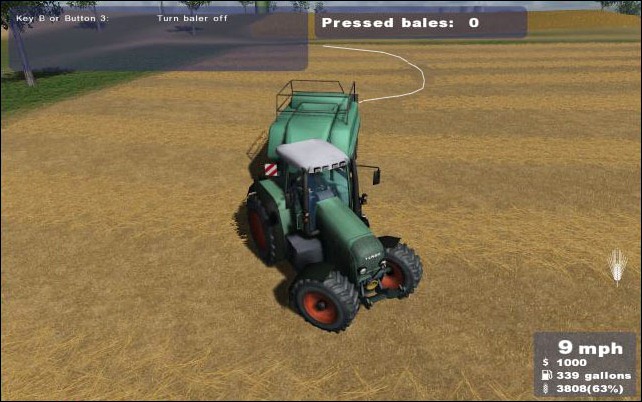
The first stage of training is just learning how to get the job done.

In the hay baling example above, a new simulation trainee learns how to steer the hay baler and begin the hay collection and baling process. Their route is semi-random as they’re getting their bearings.

Learning to Do Quickly

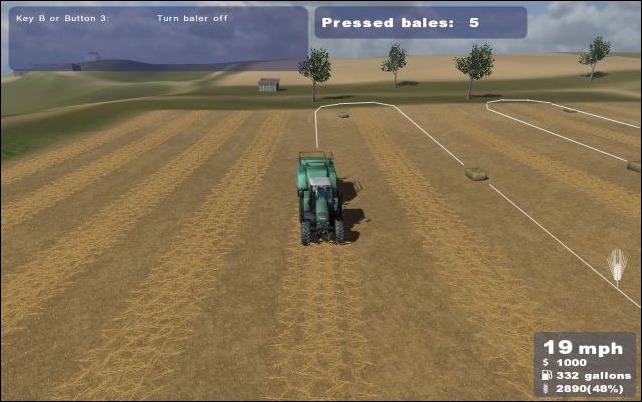
simulation-performance-improvement

After mastering the basic techniques of operating the equipment, the operator takes a systematic approach and goes row by row to collect and bale hay.

Learning to Do Optimally

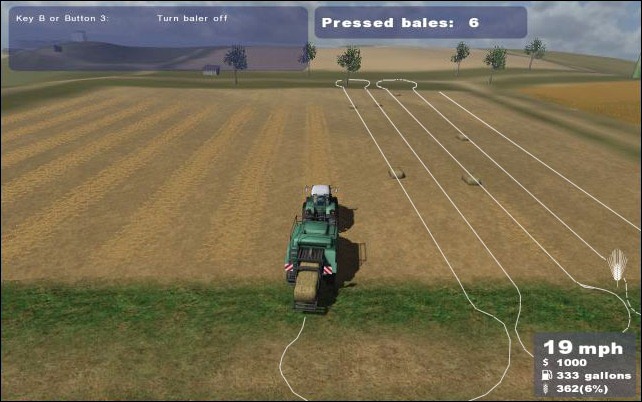
simulation-performance-optimization

By experimenting within the simulation environment, and reinforced by a tight feedback loop of performance assessment, scoring, and timing, the operator discovers an optimal approach. By taking every other row, the time consuming tight turn-around at the end of each row is eliminated and scores improve.

Bottom Line

Even in a situation as trivial and simple as the efficient operation of a hay baler, optimization techniques can be found through experimentation. The key is that the operator is having a direct experience with the training material and is able to do trial and error refinements that aren’t possible in training that is non-experiential. Consider the optimization opportunities that are present in other systems which aren’t so simple, and the value of simulation training is clear.

Tuesday, 9 March 2010

Finding Quality Real-time 3D Simulation Demos

One challenge for sponsors of new simulation projects is locating playable demos of existing simulations. One solution is to demo simulation-style retail games. While training simulations share many qualities of and often use the same technologies as retail games, they're not the same thing. Experiencing a true non-game training simulation product saves development time and money by taking advantage of design patterns that have worked for others.

An existing simulation will not include the exact equipment from your business and may not even be from the same industry, but many of the basic constructs are the same from simulation to simulation. For example, just about every simulation has a title screen, a range of user preferences or settings, ideally a tutorial mode, etc. Once into the actual simulation experience, elements such as virtual camera perspective (1st person vs. 3rd person), navigation controls, etc. also are common across a range a simulation applications.

The majority of completed training and sales simulation products are proprietary and not publicly available, but there are some notable exceptions. These are typically the more game-like simulations which have some appeal to a broad consumer audience. One example is the excellent retail Farming-Simulator 2009.

Farming-Simulator 2009 homepage:
http://www.landwirtschafts-simulator.de/index.php

Farming-Simulator 2009 demo download page:
http://www.landwirtschafts-simulator.de/demo.php

Title Screen

Settings Screen

Tutorials

Driving Tutorial

Hay Baling Tutorial

Taking an hour or so to download/install/demo a completed sim like this is time well spent. This type of demo gives your team and your simulation designer/developer a shared point of reference where you can start discussing what approaches you do and don't like and where you want your simulation to be similar or different.

Wednesday, 24 February 2010

Iraq & Afghanistan 3D Training Simulation Wins National Modeling & Simulation Award

The University of Texas at Dallas, Arts & Technology (ATEC) Wins National Modeling and Simulation Award for a 3D Interactive Program: First Person Cultural Trainer.


ATEC's First Person Cultural Trainer (FPCT) is a real-time 3D serious game that provides soldiers with the necessary training on cultural issues and values in both Iraq and Afghanistan. One of the project sponsors for the game is the US Army Training and Doctrine Command (TRADOC).

When playing the game the user must gain an understanding of social structures, values, and customs in different communities in order to navigate their way through the game and complete the four missions. In the past this kind of training was done using live actors and set creation, a costly and physically limiting solution. Using interactive 3D virtual gaming technology for non-entertainment purposes is affordable, easily distributable, and highly effective.

ATEC's FPCT has been featured at the Modeling & Simulation Leadership Summit and Interservice/Industry Training Simulation & Education Conference (I/ITSEC).

http://www.utdallas.edu/news/2010/2/23-1251_Game-Trains-Soldiers-in-a-Virtual-Iraq-or-Afghanis_article.html

Wednesday, 17 February 2010

VSTEP Releases RescueSim Platform


The thing to note about this product is that it is not simply a one-off simulation, but is instead a fully-featured toolkit to construct a variety of unique simulation scenarios (within the limits of the building blocks that are provided).

From http://www.rescuesim.com/:
RescueSim is training software that prepares public safety and security professionals for real-life incidents in a virtual environment.

RescueSim allows emergency crews to experience the incident as they would in real-life. They assess the situation and determine the best response strategy, implement it and then observe the consequences of their decisions.

RescueSim offers important benefits:
  • Train people whenever, wherever without time-consuming planning and preparation
  • Improve operational preparedness of the emergency response organisation
  • Reduce training costs
  • Learn new skills in a safe environment

Thursday, 7 January 2010

Service Rig Drilling Training Simulation

Coole Immersive's Service Rig Training is a 3D simulation that enables service rig drilling workers to learn how to perform critical mining tasks according to industry standards in a safe and cost-effective environment.


This training simulation is a great example of how industries like Mining and Construction, and Oil and Gas, can benefit from using interactive 3D simulations to train their employees without the associated risks and costs of real-world training. The simulation allows the user to train for positions ranging from an Operator all the way down to a Junior Floor Hand, including nearly 60 competency-based training modules.

Coole Immersive's Service Rig Training

Tuesday, 5 January 2010

Privacy Policy

Privacy Policy for http://heavyequipmentvehicles.blogspot.com/

If you require any more information or have any questions about our privacy policy, please feel free to contact us by email at topnklayli@gmail.com.

At http://heavyequipmentvehicles.blogspot.com/, the privacy of our visitors is of extreme importance to us. This privacy policy document outlines the types of personal information is received and collected by http://heavyequipmentvehicles.blogspot.com/ and how it is used.

Log Files
Like many other Web sites, http://heavyequipmentvehicles.blogspot.com/ makes use of log files. The information inside the log files includes internet protocol ( IP ) addresses, type of browser, Internet Service Provider ( ISP ), date/time stamp, referring/exit pages, and number of clicks to analyze trends, administer the site, track user’s movement around the site, and gather demographic information. IP addresses, and other such information are not linked to any information that is personally identifiable.

Cookies and Web Beacons
http://heavyequipmentvehicles.blogspot.com/ does use cookies to store information about visitors preferences, record user-specific information on which pages the user access or visit, customize Web page content based on visitors browser type or other information that the visitor sends via their browser.

DoubleClick DART Cookie
.:: Google, as a third party vendor, uses cookies to serve ads on http://heavyequipmentvehicles.blogspot.com/.
.:: Google's use of the DART cookie enables it to serve ads to users based on their visit to http://heavyequipmentvehicles.blogspot.com/ and other sites on the Internet.
.:: Users may opt out of the use of the DART cookie by visiting the Google ad and content network privacy policy at the following URL - http://www.google.com/privacy_ads.html

Some of our advertising partners may use cookies and web beacons on our site. Our advertising partners include ....
Google Adsense


These third-party ad servers or ad networks use technology to the advertisements and links that appear on http://heavyequipmentvehicles.blogspot.com/ send directly to your browsers. They automatically receive your IP address when this occurs. Other technologies ( such as cookies, JavaScript, or Web Beacons ) may also be used by the third-party ad networks to measure the effectiveness of their advertisements and / or to personalize the advertising content that you see.

http://heavyequipmentvehicles.blogspot.com/ has no access to or control over these cookies that are used by third-party advertisers.

You should consult the respective privacy policies of these third-party ad servers for more detailed information on their practices as well as for instructions about how to opt-out of certain practices. http://heavyequipmentvehicles.blogspot.com/'s privacy policy does not apply to, and we cannot control the activities of, such other advertisers or web sites.

If you wish to disable cookies, you may do so through your individual browser options. More detailed information about cookie management with specific web browsers can be found at the browsers' respective websites.